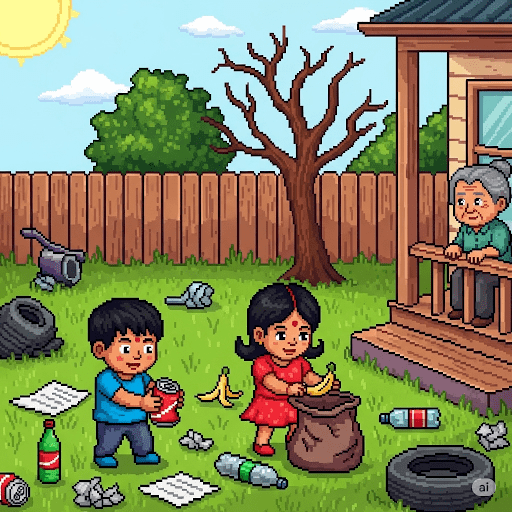
Hello my lovely village…this week let’s look at the true value of teaching your children to volunteer. To view it only as an act we engage in for the sake of others is to miss the inherent beauty of the bonding that is born out of giving our time to fulfill needs on both sides.
Volunteering, often viewed in Western societies as a charitable act or a way to build a resume, takes on a deeper, more transformative meaning when viewed through the lens of Eastern philosophy. Concepts of service, or seva, and the practice of mindfulness converge to reveal that the act of giving one’s time and energy is not merely for the benefit of others, but a profound path to personal growth, self-awareness, and the recognition of our fundamental interconnectedness. I used to take my kids to nursing homes to teach the residents- often beleaguered with physical and emotional limitations- enough computers literacy to enable joyous interactions with their families. The residents faces would light up when they were taught to view online pictures of their grandchildren, and my kids learned what was truly valuable after living long lives in our world.
Eastern traditions, particularly Buddhism and Hinduism, emphasize the interconnectedness of all beings. The self is not seen as an isolated entity but as a part of a larger, unified whole. In this context, selfless service is not an act of charity to a separate “other,” but an act of caring for a part of oneself. The Buddhist concept of karuṇā, or compassion, is not just a feeling of sympathy but an active and intentional commitment to alleviate the suffering of all sentient beings. This compassion arises from the understanding that all beings are subject to suffering (dukkha) and that our well-being is intrinsically linked to the well-being of others. Volunteering, therefore, becomes a practical application of this wisdom, a way to manifest compassion in the world and, in the process, dissolve the illusion of a separate self.
Mindfulness, a core practice in many Eastern traditions, further enhances the transformative power of volunteering. By paying attention to the present moment without judgment, we can become more aware of our motivations, emotions, and thoughts as we serve. When we volunteer mindfully, we can observe the stress, the joy, or the impatience that may arise, and instead of reacting, we can simply acknowledge it. This practice of non-reactive observation helps us to let go of unwholesome motivations, such as the desire for recognition or praise, and to focus on the pure act of giving. A mindful volunteer is not just going through the motions; they are fully present for the person they are helping, listening with an open heart, and performing the task with a sense of purpose and tranquility. This present-moment awareness transforms a simple act of service into a form of meditation, where the volunteer benefits as much, if not more, than the person being served.
When we extend this mindful, Eastern-inspired approach to volunteering to children, the benefits multiply, especially through intergenerational connections. In an increasingly age-segregated world, bringing together young children and older adults through service projects offers a powerful antidote to loneliness, stereotypes, and a lack of empathy. Intergenerational volunteering, such as a child reading to residents in a nursing home or an elderly person helping a child with a community garden, creates a unique space for mutual learning and understanding. For children, these interactions can provide a sense of purpose, boost their self-esteem, and help them develop a deeper understanding of the life cycle and the challenges of aging.
These connections are particularly vital for fostering empathy in children. Empathy is not an abstract concept; it is an emotional skill that is honed through lived experience. By spending time with older adults, children are exposed to different life stories, perspectives, and physical realities. They learn to see beyond the surface, to understand that a wrinkled face or a slow gait holds a lifetime of experiences. A child who helps a senior with a task or simply listens to their stories begins to internalize a sense of shared humanity. They learn that despite the differences in age and ability, we all share the same fundamental needs for connection, respect, and kindness. This direct exposure helps to dispel negative stereotypes about aging and fosters a natural, organic form of compassion that is not simply taught but felt and lived.
Ultimately, volunteering, when rooted in Eastern principles of interconnectedness and mindfulness, becomes more than a good deed. It becomes a practice of wisdom and compassion, a way to cultivate inner peace while contributing to the well-being of the world. For children, particularly through intergenerational connections, it is a hands-on education in what it means to be human—a lesson in empathy that will serve them far beyond the volunteer project. It fosters a generation of kinder, more understanding individuals who see the world not as a collection of separate people, but as a community bound together by the shared experience of life. In this way, the simple act of volunteering can become a powerful force for building a more compassionate and harmonious society for all.
My deepest prayer for you my friend is that you dispel your inner loneliness by experiencing your oneness with those you spend time serving.
Namaste until next week……

 The Mindful Mom
Leave a comment